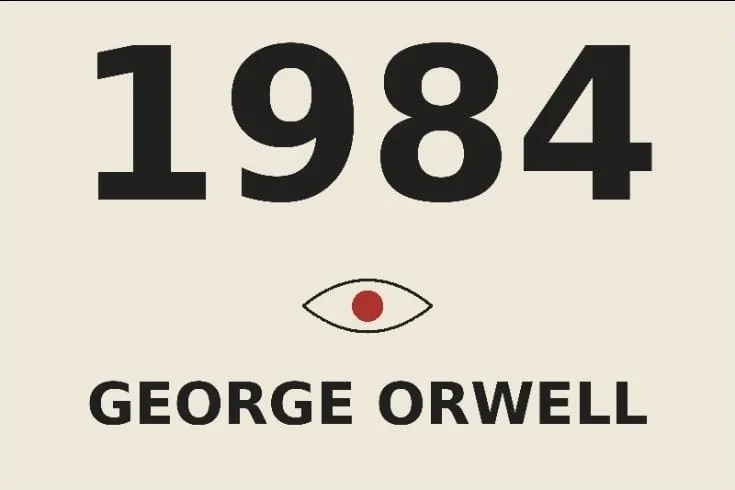
It has been more than thirty years since I first read 1984. At the time, I closed the book and went on with my life—to airplanes, airports, and journeys that carried me from one city to another and from one continent to the next. But today, with the roar of engines now behind me, I find myself returning to that novel in memory. Not simply to recall its events, but to confront a question that did not strike me with the same depth when I first read it: How did a man writing in 1949 imagine a world only thirty-five years ahead, call it 1984, and create a society in which truth could be altered, private life could be watched, and history, language, and memory could all be reshaped?
George Orwell published 1984 in 1949, but he did not live long enough to see the extraordinary impact the novel would have. He died in 1950 at the age of forty-six, only months after its publication. Yet the book would keep his name alive for generations.
What continues to astonish me is the world in which Orwell was writing. Humanity had only recently emerged from the horrors of World War II. There was no Internet, no smartphone, no social media, no artificial intelligence, and no network of digital cameras surrounding daily life. And yet Orwell imagined a state called Oceania, ruled by a Party that stood above the individual under the all-seeing image of “Big Brother.” Screens did not merely deliver official messages; they also watched the people receiving them.
The novel’s central character, Winston Smith, works at the Ministry of Truth—an almost cruelly ironic name, because his job is not to protect truth but to rewrite it. He returns to old newspapers and records and changes them whenever the Party changes its position. Yesterday must always agree with today. The past is no longer fixed, memory is no longer secure, and truth itself can be rewritten, republished, and then presented as though the previous version never existed.
Orwell went even further. He imagined the Thought Police. He imagined a new language in which words were gradually reduced, because fewer words meant fewer possibilities for independent thought. He imagined love itself becoming an act of rebellion, as it does in Winston’s relationship with Julia, because total control is never satisfied with public obedience. It wants entry into the last private room a human being possesses: the mind and the heart.
And so, in 2026, I find myself asking a simple question: If Orwell were alive today, what would he see?
I would not say that his prophecy has come true exactly. The world is far more complicated than that, and our societies are not one vast Oceania. But perhaps Orwell would be struck by a development even he may not have fully imagined: modern human beings no longer need a screen imposed on the wall by the state. We willingly carry one in our pockets from the moment we wake up until the moment we go to sleep.
Through a small phone, we find our location, share photographs, buy what we need, make payments, read the news, express approval and outrage, and reveal—often without fully realizing it—enormous amounts of information about our habits, interests, movements, and choices. In the digital age, questions of surveillance, privacy, artificial intelligence, and the control of information have become central to the global debate over individual freedom.
Perhaps Orwell would be even more astonished by artificial intelligence and its ability to create an image of a person who never stood before a camera, a voice recording of words that were never spoken, or a video that appears authentic even though the event never happened at all. In Orwell’s fictional world, Winston needed an entire ministry to rewrite yesterday’s news. In ours, a person sitting alone in front of a screen may be able to manufacture, within minutes, something that looks like visual proof of an event that never took place.
That changes the question.
The danger is no longer only: Who is hiding the truth?
It is also: How do I know that what I am seeing is true in the first place?
More than forty years in aviation taught me that having more instruments does not automatically make you safer. What matters is knowing how to read them, compare them, and recognize when one reading does not make sense. A pilot does not survive because he has many gauges. He survives because he has learned never to surrender his judgment to a single instrument when all the other evidence points in another direction.
I believe the human mind in 2026 needs the same discipline. We possess more information than Orwell could ever have imagined. But possessing information is one thing; knowing what deserves to be believed is something else entirely.
If Orwell were sitting among us today, I cannot claim to know what he would say. He has been gone for decades. But I can imagine him looking at our phones, our artificial intelligence, and the endless flood of information that surrounds us, and perhaps asking a question even harsher than anything in his novel:
Has humanity become freer because it knows more, or more easily directed because it no longer knows which parts of what it knows deserve to be trusted?
What I understand now, more than thirty years after first reading 1984, is that the true power of the novel was never simply its prediction of future technology. Its deeper insight was its understanding of an old human weakness.
Technology changes. Fear does not. The tools of deception change. Deception itself does not.
The names given to power change. The desire to control remains. The sky taught me that the most dangerous moment in flight is not when you are off course and know it. The real danger is being off course while believing you are exactly where you should be.
The greatest danger in 2026 is not that someone may lie to us. Human beings have lied to one another since the beginning of history. The greater danger is that we may live surrounded by more knowledge than any generation before us and still lose the habit of questioning; that every tool of verification may be in our hands, yet we choose to accept whatever arrives already packaged for us.
If Orwell feared, in 1949, a future in which others would tell people what they were required to believe, then perhaps the more disturbing question in 2026 is this:
What happens when people voluntarily give up their right to verify the truth for themselves? At that point, we are not defeated because Big Brother is watching us. We are defeated because we have extinguished the last guardian within ourselves.
And when that inner vision goes dark, lies no longer need a prison, and power no longer needs a whip.
It is enough for a person to lose the courage to question, walk willingly toward the chains, and still believe the path was freely chosen.