Saudia: When the Dream Became as Large as a Boeing 747
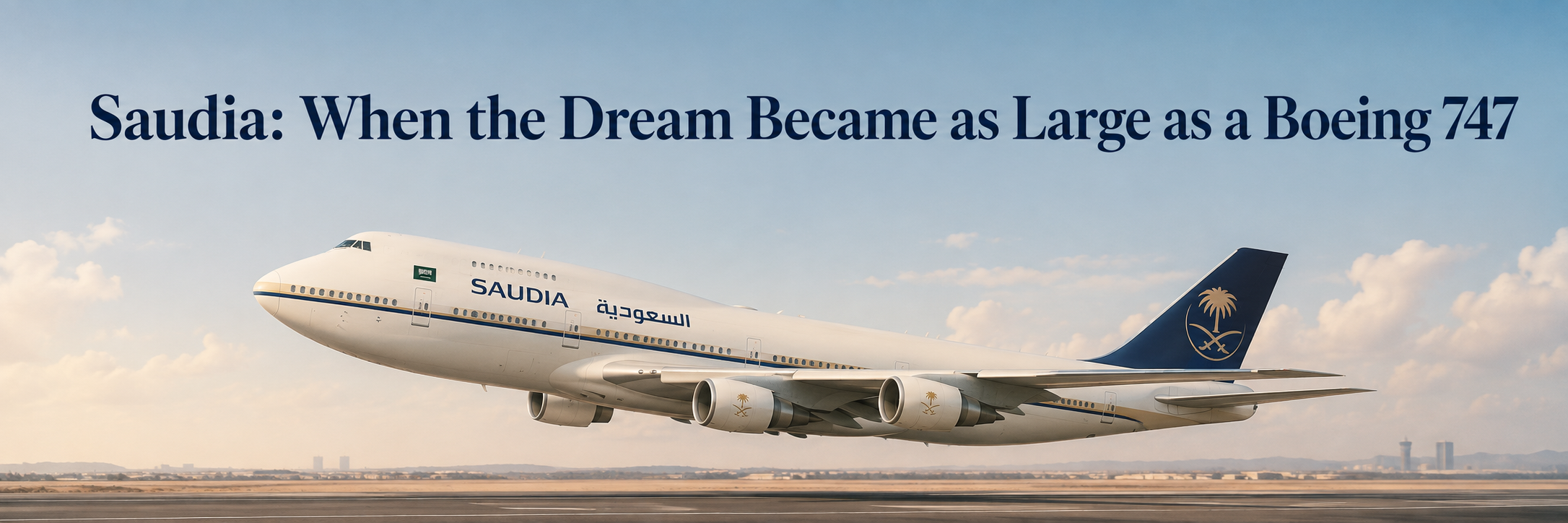
Some news enters a person’s life in only a few words, yet changes the direction of everything that follows. When I was told that I was one of eight pilots selected to travel to Jeddah for training and service with Saudi Arabian Airlines on the Boeing 747, I understood that a new door had opened before me. A dream that had long seemed distant in the sky had suddenly come close enough to touch.
The Boeing 747 was not an ordinary aircraft in the imagination of pilots. At that time, it represented a new era in aviation—a giant machine capable of carrying hundreds of passengers across continents and oceans. To work in its cockpit meant entering a different level of knowledge, discipline, and responsibility. The challenge was not simply to learn its systems and procedures. It was to prove worthy of the trust that had placed me there.
We left for Jeddah carrying both pride and uncertainty. Every important step in life is accompanied by a quiet fear that we may not be equal to it. But I had already learned that professional fear is not weakness. It is evidence that a person understands the weight of the responsibility before him. A pilot who feels no concern may be more dangerous than one who is afraid, but places that fear under the authority of training, judgment, and discipline.
In Jeddah, we entered a professional world built on precise organization, accumulated experience, and an operating culture that understood a basic truth: flight safety begins long before an aircraft leaves the gate. The instructors and colleagues did not treat us as temporary visitors. They welcomed us as partners in a shared responsibility. They offered their knowledge generously, opened the doors of their experience, and surrounded us with a level of respect that made learning deeper and adaptation easier.
There I came to understand that professionalism is not found in advanced equipment alone. It is also revealed in the way people treat one another. A great airline is not measured only by the size of its fleet, but by its ability to build trust among its people and to create a culture in which every employee feels personally responsible for the success of the flight.
When the training was complete, the long-haul journeys began. They carried me to cities that had once been nothing more than distant names on a map. I flew to Washington and New York, then across Europe to Paris, London, Frankfurt, and Rome. Later, the routes extended into Asia, the Far East, and Southeast Asia. Every destination opened a new window on the world, and every airport added another question to my understanding of life.
A flight was no longer simply a departure and an arrival. It became a passage between cultures and different ways of seeing time, work, ambition, and belonging. I saw cities moving so quickly that they seemed afraid of being overtaken by the future, and others living more quietly, as though they had made peace with time. People differed in language, dress, and custom, yet they became remarkably similar in moments of farewell, in waiting for someone they loved, in the tension of turbulence, and in the relief that came when the wheels touched the runway.
As the world grew larger around me, Jeddah grew closer within me. The city gave me something that no workplace alone can provide. In its streets, homes, and gatherings, I found a familiar Arab warmth and a generosity that did not wait for a special occasion. I did not feel that I was living in a foreign city. It felt more like a second home—distant in geography, but near in spirit.
My relationship with our Saudi colleagues became one of the most meaningful parts of that chapter. We were connected not only by flights, but by long days, training sessions, delays, challenges, and the moments that reveal a person’s true character beyond rank and formality. With time, we were no longer simply coworkers. We became friends bound by trust, each knowing that the others would stand beside him when the sky became difficult.
Every time I sat in the cockpit of the Boeing 747, I felt proud. That pride did not come from the size of the aircraft alone, but from what the experience represented: the expansion of a dream. A person may begin his career with a modest ambition, then discover that steady work can open doors he once lacked the courage even to imagine. Each time the aircraft climbed, I felt that I was not only flying it. I was rising beyond old limits I had placed in my own mind about what was possible.
But life does not always follow the logic of a flight schedule. On August 2, 1990, Iraq invaded Kuwait, and the political landscape of the region changed within hours. The news was no longer something distant on an evening broadcast. It entered our professional lives and forced a direction we had not chosen. We were instructed to leave the Kingdom and return home, and the chapter ended sooner than any of us had expected.
The farewell was difficult because we were not leaving behind only a job. We were leaving friends, memories, and a life that had begun to acquire the feeling of stability. I saw genuine sadness in the faces of our Saudi colleagues and understood that relationships built on trust do not end because of an administrative decision or a political crisis. Flights may stop, but what people create between one another does not always obey the timetable of departure.
I returned home carrying two opposing emotions: grief for an experience that had ended before its time, and gratitude that it had happened at all. It would have been easy to define the ending as a loss. But the years taught me that the value of an experience is not measured only by its duration. It is measured by what it changes within us.
Saudia taught me that great opportunities do not simply give us achievement. They require us to grow inwardly until we are capable of carrying them. The Boeing 747 taught me that responsibility expands with the dream, and that anyone entrusted with human lives has no room for arrogance or carelessness. Jeddah taught me that a place can become close to the heart long before one has lived there for many years.
That chapter ended, but its influence did not. The experience remained. The friendships remained. The cities I had seen from the cockpit remained. And so did the memory of the first moment when I was told that I would fly the aircraft that had once seemed larger than the dream itself.
Some journeys are not given enough time to end as we planned, yet they still place us on the road we needed. Some endings do not extinguish ambition. They release it from attachment to a single path.
I left Jeddah, but I never left the experience behind. Something of it remained in every decision I made afterward, in every responsibility I carried, and in every moment when I looked toward the sky and remembered that even the most distant dream may one day become a giant aircraft waiting for you to step forward, take your seat, and accept the responsibility of command.