What Was… Cannot Be Erased
Morning Reflection
This morning was not like any other… it was heavy with a memory that awakened before I did, and with a story that began only a few days ago, when I visited a dear friend I have known for more than forty-five years, in his warm home in Iskan Alia — my respected brother, Mohammad Al-Nimroti (Abu Fares).
We sat in the garden, where the air tells what words cannot, and where silence carries a meaning that cannot be bought.
We were not alone… with us was our dear friend Nabil Al-Talh (Abu Al-Saeed), a man who was not merely a friend, but a luminous page from the history of Jordanian sports — one of the most distinguished football players who left an unforgettable mark. A man whose character preceded his achievements, and a living memory of a beautiful era.
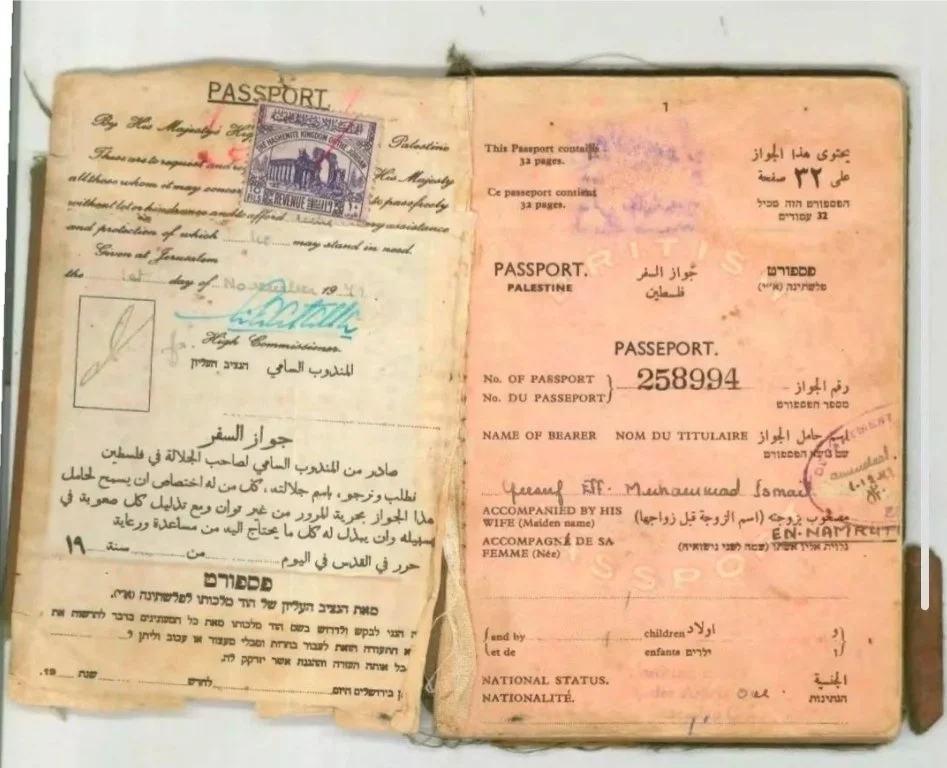
As we spoke of the past, Abu Fares quietly rose, then returned carrying his father’s old passport. We opened it together, as if we were opening a door into history. Faded pages, yet full of life, bearing the name “Palestine” with a clarity that allows no interpretation.
And today, as I share images of this passport, I realize that some evidence cannot be denied… because it simply was — and still is.
This morning, I no longer saw paper as paper… I saw it as a homeland — as existence that time cannot erase.
Evening Reflection
In an evening that resembled old stories, where the night breeze slipped gently through the trees like messages from another time, I found myself sitting once again in Abu Fares’ garden in Iskan Alia — as if I were not in a place, but in a moment beyond time.
The sky above us was clear, yet not silent… it was filled with a history unseen, but deeply felt.
The three of us sat together — Abu Fares, Abu Al-Saeed, and I. Abu Al-Saeed — a name that, when spoken, brings with it an entire era of Jordanian sporting glory. He was not just a football player, but a walking memory, a story on two feet — a man who carried in his presence the simplicity of the great, and the calm of those who understand the value of what they have lived.
Our words flowed like an ancient river — a river that knows its path even when the land around it changes. We spoke of days that have passed, yet never truly left; of faces that are gone, yet never disappeared; of a homeland that was never merely an idea, but always a truth.
And Abu Fares… that man who sits with the quiet wisdom of the thoughtful — he listened more than he spoke, yet his presence alone gave weight and meaning to every word. A man who embodies deep knowledge, refined character, and a humility that is never forced. In his eyes, you see years of understanding; in his words, you feel that truth needs no ornament.
Then suddenly, as if a moment had ripened enough to be revealed, Abu Fares stood, went inside, and returned holding something that seemed ordinary… yet was anything but.
An old passport.
When we opened it, we did not open paper… we opened time. The pages made a faint sound, as if whispering: “I am here… I never left.” We saw the name, the photograph, the small details that some might overlook — but in that moment, they were greater than any speech, more truthful than any narrative.
And the name “Palestine” was there — present, clear, unwavering… needing no explanation, accepting no denial.
In that moment, I felt I was not looking at a passport, but at a document of existence — a living proof that what was… truly was.
And here begins the deeper dimension: philosophically, what has existed cannot be undone. It may be reinterpreted, it may be denied, but it remains — because it happened. And truth, once it occurs, does not need permission to endure.
Time — which we sometimes fear — was not an enemy in that moment, but a witness. A witness that whatever withstands it… deserves to remain.
This passport, whose images I now share, is not merely a personal document. It is a fragment of history, a piece of evidence that cannot be denied — because it does not rely on narration, but on lived reality.
For a moment, I imagined… how many hands held this passport? How many roads did it travel? How many stories does it carry in its silence? As if it did not merely journey across countries, but across time itself — until it reached us, to say: Do not forget.
And here, the greater truth reveals itself: homelands do not disappear when they are fought… they disappear when they are forgotten.
And Palestine? It has not been forgotten… and it never will be.
Because it is no longer just land — it has become memory, an idea, a feeling that lives within those who have known it, even if they have never seen it.
On that evening, we were not just three men… We were three witnesses. Three moments in time. Three voices saying the same truth in different ways: That truth does not die. That memory does not betray. And that what was written in truth… will remain, will endure, and will be told — no matter how long time passes.
Because what was… cannot be erased.