80 Years of Independence… Yet We Still Litter
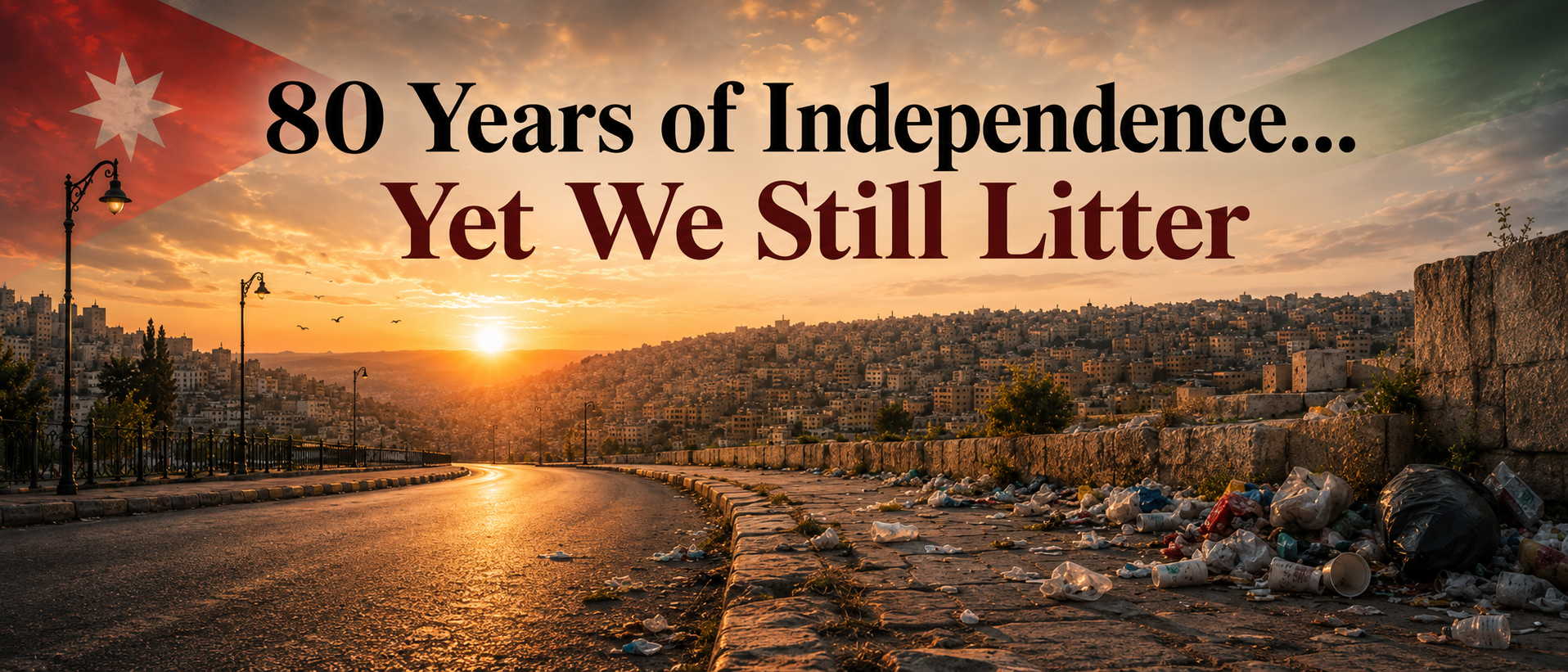
This morning, I write with a sadness that refuses to fade, and with a pain that repeats itself just as the same ugly scenes repeat on sidewalks, roads, mountains, valleys, and public spaces.
I write about my homeland, which is preparing to celebrate its eightieth Independence Day — a homeland that has grown in age, risen in meaning, and paid so much from its history, dignity, and the sacrifices of its people. Yet some among us remain too small before a simple bag of garbage, unable to carry it to its proper place.
I have written about this phenomenon many times, and I will continue to write about it again and again — not because words alone can clean the streets, but because silence in the face of ugliness is a form of participation in it.
I write because sadness, when buried, turns into helplessness. And because the question still stands like a lump in the throat:
Until when?
Until when will we raise the flags of the homeland on national occasions, then throw our filth on its soil on ordinary days?
Until when will we sing for independence while we have not yet liberated ourselves from an ugly habit called indifference?
Until when will we demand a clean country while exhausting sanitation workers with the chaos our own hands create?
And until when will we confuse loving the homeland with words, while betraying it in the smallest details?
Throwing garbage is not a simple act, as some may think. It is not just a piece of paper blown away, an empty can, or a plastic bag left on the side of the road.
It is a clear declaration of a crisis of awareness, a defect in upbringing, and a conscience that has lost its respect for place.
Whoever throws garbage in the street does not only pollute the ground; he pollutes the meaning of citizenship, wounds the face of the homeland, and leaves an ugly fingerprint on the memory of the place.
What is strange and painful is that we clean our homes with care, and we become angry if the entrance of our house is dirtied. Yet once we step outside, we act as if the street does not belong to us, as if the homeland begins at the doorstep of our house and ends there.
What kind of distorted logic is this?
What kind of culture makes a person extremely sensitive about the tiles of his home, yet completely insensitive toward the soil of his country?
The homeland is not a poem we recite on Independence Day. It is not a flag we raise during celebrations. It is not a beautiful post we write on social media.
The homeland is a daily test of conscience.
The homeland appears in a hand that refuses to throw garbage, in a father who teaches his child that the street is a shared home, in a driver who does not open his window to throw his dirt onto the road, and in a citizen who understands that cleanliness is not the responsibility of the municipality alone, but the responsibility of every person who respects himself before respecting his country.
Yes, there is failure in monitoring. There is weakness in penalties. There is a defect in awareness campaigns, and perhaps a long absence of accountability.
But the harsher truth is that the problem does not stop at the law. It begins inside us — in a conscience that has become used to throwing and walking away, and in a mind that believes someone else was created to clean up after it.
The sanitation worker is not a servant of our mistakes.
He is a human being who tries every morning to repair what we have broken of the city’s image.
We are the ones who throw, and he is the one who bends down.
We are the ones who distort, and he is the one who tries to restore.
What kind of injustice is this — that we create ugliness with our own hands, then place the burden of cleaning it on someone else?
On the eightieth Independence Day, we do not only need speeches about dignity, sovereignty, and achievement.
We need another kind of independence as well: independence from chaos, from indifference, from the culture of “it is not my problem,” and from that moral laziness that allows a person to see filth before his eyes without his conscience moving.
Nations are not measured only by skyscrapers, slogans, or official celebrations.
Sometimes nations are measured by a clean sidewalk, a park that is not insulted, a beach that is not suffocated by plastic, and a road that has not been turned into an open garbage dump.
Good morning to a homeland that deserves more from us than words.
Good morning to a homeland tired of our seasonal love, our loud songs, and our small actions that contradict everything we say.
Good morning to a homeland celebrating its eightieth Independence Day, still waiting for some of its people to achieve the independence of conscience.
And the question will remain painful, sharp, and open:
Until when will we love the homeland with our tongues… and hurt it with our hands?