The Day After Jordan Independence
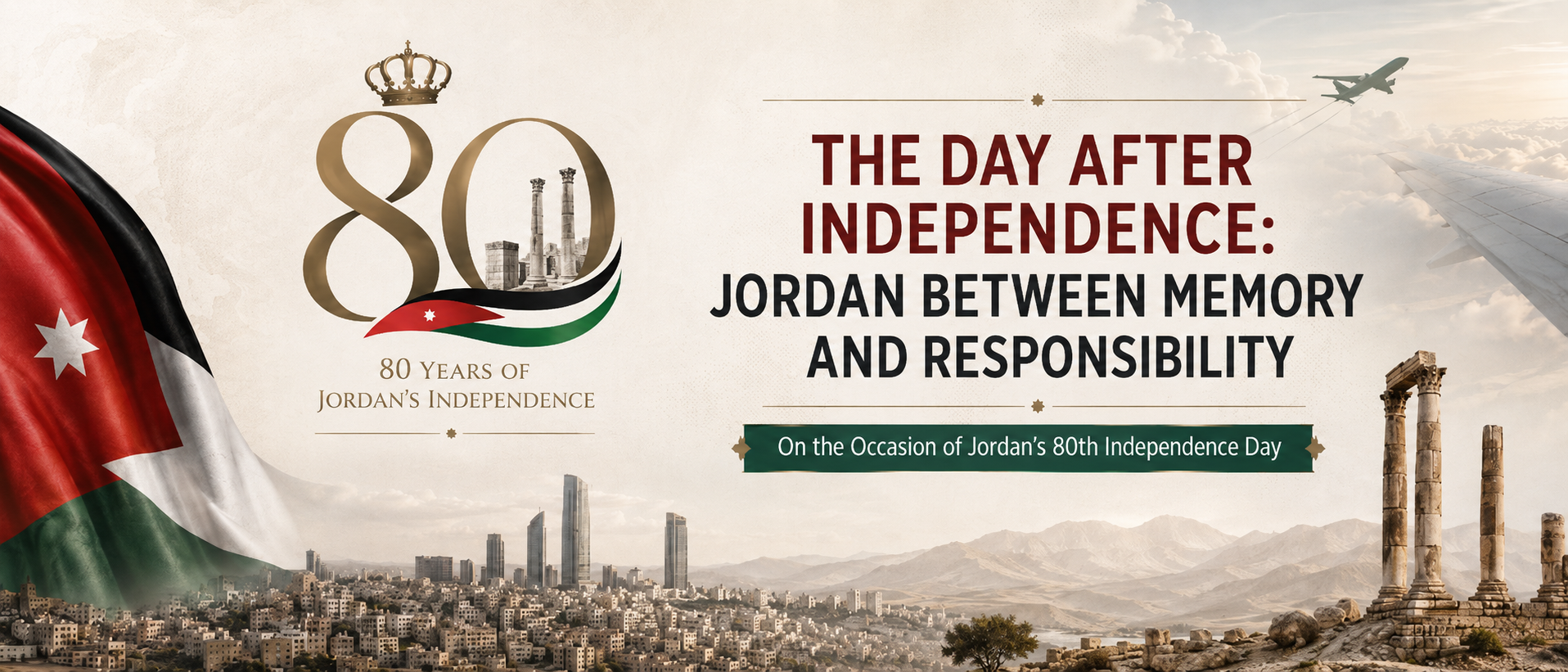
A few days ago, I wrote about Jordan’s 80th Independence Day. I wrote with anticipation, before the celebration, when the occasion was still approaching with all its symbols: flags, songs, memories, and the deep national emotion that returns every year on May 25.
Today, I write again — but this time after the day of celebration has passed.
There is a different kind of honesty in writing after a national holiday. Before the occasion, we write with expectation. During it, we write with pride. But the day after, when the noise settles and the streets return to their normal rhythm, we are left with the deeper question: What remains after the celebration is over?
Independence is not only a date on the calendar. It is not merely a flag raised, a speech delivered, or a song repeated with emotion. Independence is a responsibility renewed every day. It is a test of whether a nation can protect not only its borders, but also the dignity, confidence, and future of its people.
I write these words not as a distant observer, but as someone whose life has moved alongside the story of this country. I am a retired pilot. For many years, I saw Jordan from the ground and from the sky. I saw its cities, deserts, mountains, valleys, and villages from above, and I learned that a homeland is not measured by its size on a map, but by its ability to remain present in the hearts of its people.
I was born in October 1955. Jordan’s independence was declared on May 25, 1946. That means that when I was born, Jordan’s independence was only about nine years and four months old. In a way, I was born while the independent Jordanian state was still in its early childhood. I grew older as Jordan grew stronger. I watched, in my own lifetime, a young country build its institutions, face its storms, and search for its place in a difficult region.
This comparison is not just a matter of numbers. It is personal. When I was a child, Jordan was still shaping its identity as a modern independent state. Today, as I look back after its 80th Independence Day, I feel that I am not only reading the history of a nation; I am reading part of my own life.
Jordan’s journey has never been easy. Since 1946, this country has not enjoyed the luxury of abundant natural resources or a calm geography. It has lived in the heart of a region marked by wars, displacement, political tension, and economic pressure. Yet Jordan has remained standing. That alone deserves respect.
Jordan deserves praise because it preserved its statehood while many around it were shaken. It protected its institutions, army, security, education system, and public life through decades of uncertainty. It remained a home for its citizens and, at many times, a refuge for others. It carried burdens larger than its size and continued to speak with moderation in a region often overwhelmed by anger and noise.
But love of country does not mean silence in the face of its difficulties. True patriotism is not blind praise. A nation is not served by pretending that everything is perfect. It is served by honesty, by responsible criticism, and by the courage to say that some things must change.
Jordan today faces serious challenges. Many young people are struggling to find opportunity. Families are under pressure from the cost of living. Development is still uneven between the capital and the governorates. Bureaucracy too often exhausts citizens instead of serving them. Favoritism and connections still wound the idea of fairness. These are not attacks on the homeland. They are concerns born from love for it.
On Independence Day, we raise the flag high. That is a beautiful and necessary act. But after Independence Day, we must ask whether we are also raising the quality of justice, education, public service, and economic opportunity. A flag is not truly high only because it flies above a building. It is high when the citizen beneath it feels respected, protected, and hopeful.
Jordan has succeeded in preserving stability, and that is no small achievement. Those who have seen chaos know the value of stability. But stability should not be the end of our ambition. It should be the foundation on which we build something greater: a stronger economy, better education, cleaner administration, fairer opportunity, and a public life in which citizens feel that their voices matter.
The meaning of independence has changed with time. In the past, independence meant sovereignty, borders, and the right of a country to make its own decisions. These remain essential. But in our time, independence must also mean freeing the citizen from fear, poverty, corruption, and hopelessness. It must mean that a young Jordanian does not feel like a stranger in his own country, or that his future depends more on connections than on competence.
A country does not need citizens who only applaud. It needs citizens who participate. It does not need silent love; it needs active love. It does not need fear of criticism; it needs the wisdom to distinguish between criticism that destroys and criticism that builds. Nations do not grow through praise alone, nor through constant complaint. They grow through people who love them enough to defend their achievements and confront their failures at the same time.
After the celebration, the image of the homeland becomes clearer. We see the pride, but we also see the fatigue. We see the achievements, but also the shortcomings. We see a state that has endured, a society that has carried much, a youth waiting for a wider horizon, and a future that requires brave decisions.
This does not diminish Jordan. On the contrary, it makes Jordan more real and more human. A homeland is not a perfect painting without scratches. It is a house we love enough to repair whenever it needs repair.
After 80 years of independence, the most important question is not simply: What have we achieved? The deeper question is: What will we do next? What kind of Jordan do we want to leave to our children? A Jordan that merely survives, or a Jordan that rises? A Jordan that only protects its memory, or one that builds its future with courage?
Jordan deserves to be celebrated. But more than that, it deserves to be served. It deserves praise when it succeeds, criticism when it falls short, protection when it is threatened, and reform when reform is needed. A homeland is not an idea we admire from a distance. It is a responsibility we carry from within.
Yesterday was the celebration of independence. Today is the test of loyalty to it.
The real meaning of independence begins after the songs fade, after the flags are folded, and after the speeches end. It begins when each of us returns to our work, our institutions, our families, and our conscience, and asks: Am I part of this country’s strength, or part of its burden?
Independence is not a memory that ends with a national holiday. It is a promise renewed every morning.
Jordan, after 80 years, is still capable of writing a more beautiful chapter in its story — if we have the courage to love it honestly, criticize it responsibly, and work for it faithfully.
Yesterday was Independence Day. Today is the day of responsibility. Celebration raises the voice, but work raises the nation.