The Jordanian Story on the 80th Independence Day
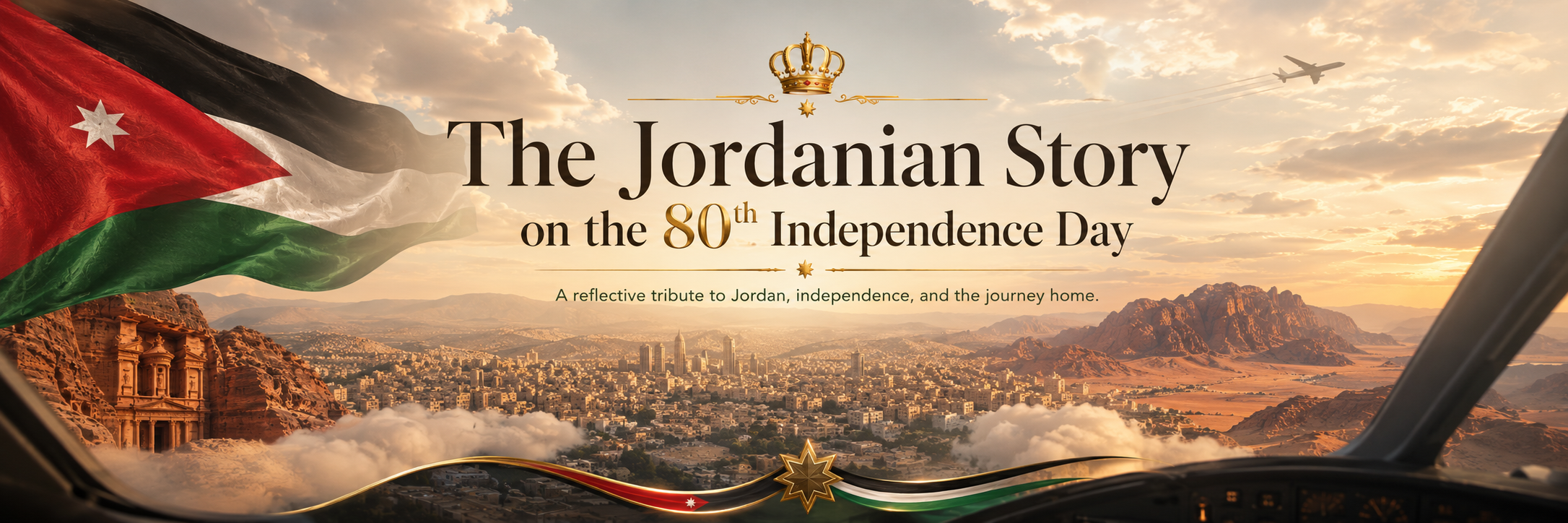
On the twenty-fifth of May, I do not see Jordan celebrating its Independence Day the way passersby from a distance might see it. I see it as I once saw it from an airplane window, when Amman appeared beneath the clouds like a small idea that resisted the wind, then grew until it became a homeland.
From above, borders do not look like lines on maps. They look like a long test of what it means to endure. And anyone who has spent more than forty years between airports, the sky, and the return home knows that nations are not measured by their size, but by their ability to give their people a reason to come back.
Jordan’s independence was not a single moment of celebration that ended, nor was it merely a flag raised one morning and then left to history. It was the beginning of a difficult journey, much like an aircraft taking off in turbulent weather. It needs a captain who knows the direction, a crew that trusts one another, and passengers who believe that arrival is possible despite the shaking along the way.
Since 1946, Jordan moved from the era of the emirate into the era of statehood. But this state was not built on an abundance of resources or the comfort of geography. It was built on the patience of its people, the awareness of its leadership, and the ability of its institutions to remain steady amid storms that never truly stopped.
Whenever I flew over the Jordanian desert, I felt that this land gives nothing easily. The desert flatters no one. But it teaches resilience, and it reveals that life does not always require abundance in order to continue. It requires a will that knows how to manage little with wisdom.
That is exactly what Jordan has done over nearly eighty years of independence. It was never a country rich in natural wealth, but it was rich in the meaning of statehood. A small country in size, limited in resources, surrounded by major crises, and yet it remained standing where others stumbled.
Independence, at its core, is not only for a state to declare its sovereignty. It is for that state to prove every day that it can protect that sovereignty from erosion. Some countries possess oil, rivers, and seas, yet lose themselves at the first storm. Others possess little more than political wisdom and the resilience of their society, and they survive.
Jordan belongs to the second kind. It has faced wars, received waves of refugees, and carried economic and social burdens far beyond its size. Yet it has not lost its compass. In my view, this is not a political coincidence. It is the result of a state culture that learned early on that moderation is not weakness, balance is not hesitation, and patience is not helplessness.
When we speak about schools, hospitals, roads, and institutions, we should not see them only as numbers in official reports. A school in a distant village is not just a building; it is a declaration that a child on the margins deserves a chance. A hospital in a remote governorate is not merely a service; it is a promise that a human life is not worth less because it is far from the capital. And a road connecting the north to the south is not just asphalt; it is a thread of trust between the citizen and the state.
This is how nations are built: not by speeches alone, but by quiet accumulation that few applaud loudly, yet that protects society from collapse.
Still, loving one’s country does not mean closing one’s eyes to its pain. A pilot knows that reading the instrument panel honestly is more important than false reassurance. Jordan today faces serious challenges: heavy public debt, unemployment that weighs on young people, development gaps between the capital and the governorates, and growing pressure on services and infrastructure.
These are not minor details. They are major questions about the future of the state. The great stability Jordan has preserved must now be transformed into fair development that citizens can feel in their work, income, roads, schools, hospitals, and in the future of their children.
Today’s young Jordanian generation does not want poems alone. It wants a horizon. It wants to feel that its effort at university will lead to an opportunity, that its competence will open a door, and that the state which protected stability is also capable of protecting the dream.
This is the real test of the coming decade: independence must not remain only a beautiful memory in the national conscience. It must become a new economic and social project, one that is more just, more courageous, and more efficient. Nations that do not renew their meaning with each generation risk turning their history into nothing more than a picture hanging on a wall.
Many governments have come and gone in Jordan. Policies and programs have changed. The state has passed through difficult stages, yet it has preserved its essence. That in itself is a rare lesson in a region accustomed to great fractures.
The survival of institutions, the continuity of the army, the resilience of education, the presence of public administration, and the cohesion of society are not ordinary things. They are the pillars of a Jordanian house built slowly, perhaps with fatigue, and perhaps with mistakes as well. But it has remained a house capable of repair, not collapse.
From the airplane window, I used to see Jordan as small on the map, but it was never small in meaning. I saw its cities, deserts, mountains, and valleys as chapters of one book, a book written more by the patience of its people than by the statements of governments.
And with every descent toward Amman, I felt that returning home was not the end of a journey, but the beginning of a question: What have we done to make this homeland worthy of remaining stronger, fairer, and more beautiful?
On the 80th Independence Day, I do not want to write about Jordan as if it were a complete story without flaws. Jordan is not a myth free of imperfections. It is a difficult human and political experience, with achievements worthy of pride, mistakes worthy of review, and challenges that must not be postponed.
Yet despite everything, it remains a homeland that has known how to live amid storms without losing its name, its face, or its spirit.
Perhaps the greatest meaning of Jordanian independence is that it was never a promise of perfection. It was a long training in how to remain standing with dignity. For the state to remain upright, for the people to remain attached to it, and for the flag to remain raised not as a piece of cloth, but as memory, duty, and responsibility.
This is Jordan as I understand it after a lifetime in the sky: a nation that does not claim it has arrived, but knows how to continue the journey.