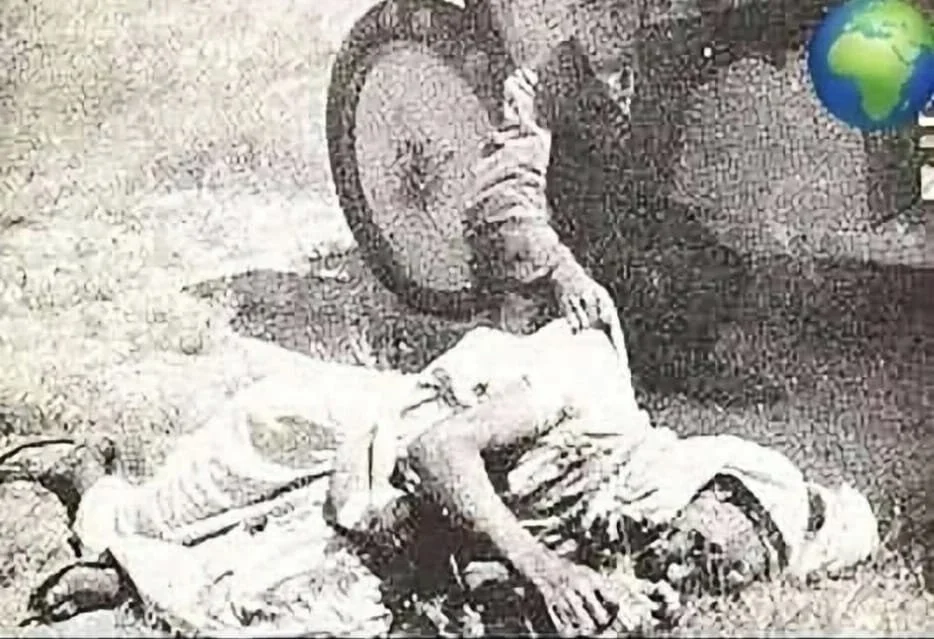
What hurts most about the photograph circulating under Omar Mukhtar’s name is not simply the stillness of the body. It is what the distance between his time and ours reveals about us. We look at a man whose life ended defending his homeland, then turn to a present in which tragedy returns under different names. The uniforms change. The weapons grow more sophisticated. Airstrikes are broadcast live, and the death toll keeps climbing. Yet the person driven from home knows the same fear. Only our language grows more skilled at explaining what is happening, as though explanation could somehow make up for inaction.
Attributing this photograph to Mukhtar’s body requires evidence beyond the caption beneath it. But the question it raises reaches beyond the identity of the dead. Why does the victor insist on displaying an opponent’s helplessness even after death? Perhaps because conquering a body does not guarantee control over what that person represents. The conqueror wants the ground beneath the fallen resistance fighter to mark the end of defiance, only to discover that a photograph can preserve the defeated long after those who stood over them have faded from memory.
This is what brings Omar Mukhtar into the Palestinian story without forcing two different historical experiences into a perfect parallel. Their connection runs deeper than circumstance. It rests on the right to live on one’s land, to have a home that anchors one’s existence, and to claim a future that does not depend on permission from a controlling power. The tragedy begins when people must justify remaining on their own land, while those restricting their lives claim the authority to define security, borders, and the conditions of survival.
In Gaza, this question takes its most devastating form. A collapsing home holds more than concrete and stone. It holds the rhythm of a family’s days, a window where a mother waited, rooms that remember children’s footsteps. When all of it becomes rubble, counting destroyed buildings cannot begin to measure the loss. An intimate world is uprooted. Trust in life fractures. A child learns too early that the ceiling meant to shelter sleep can become a source of terror. What meaning remains in the world’s language of humanity when protecting these basic conditions of life requires so much negotiation?
In the West Bank, the tragedy follows another rhythm. A day can appear ordinary. People go to work. Stores open. Yet their lives remain suspended at a checkpoint, along a closed road, or beneath the fear of a raid. Reaching a destination becomes part of the struggle, and years are consumed by waiting no one freely chose. Control extends from land to time, from physical movement to the ability to make plans. Someone who cannot count on reaching a workplace, a university, or a field is forced to experience each day as a provisional possibility.
That is why Palestinian statehood means more than a phrase repeated in diplomatic statements. It raises the question of who controls Palestinian lives and whether Palestinians can build their future on secure rights. In human terms, a state provides a shared framework of law and responsibility, where citizens can hold their government accountable and understand the limits of its authority and the scope of its obligations. When their fate remains divided between foreign promises and shifting power, the future itself becomes a means of pressure.
Then come Israeli elections. Names move to the foreground. Competition intensifies. Seats, coalitions, and political calculations dominate the coverage. It is reasonable to examine differences between platforms and the consequences of changing governments. Those differences can affect lives and should not be dismissed with an angry phrase. But Palestinians face a question more immediate than who wins and who loses. What will change in their freedom, their children’s safety, their ability to remain on their land, and the possibility of having a state of their own?
Here, a Jordanian saying takes on its bitter force. “Vinegar is mustard’s brother.” Different flavors, much the same bitterness. The saying becomes understandable when people living under injustice see political alternatives competing more vigorously over how to manage their circumstances than how to end the injustice itself. Candidates may differ in approach, timing, and alliances. The standard for judging them must remain what they do about Palestinian rights. A new name carries no moral guarantee. A leader who speaks persuasively to the world may leave the same fear waiting at a Palestinian family’s door.
The problem reaches beyond Israeli ballot boxes. It includes a world that devotes more attention to changes in government than to the continuing denial of rights. After every political contest, we are expected to suspend the fundamental questions and wait for another coalition to take shape. Meanwhile, children grow older, years disappear, and families’ capacity to endure wears down. Time that diplomacy treats as another opportunity can mean an irreversible loss to people living under siege or displacement.
If Omar Mukhtar were among us, perhaps he would be struck by this ability to turn a right into a postponed appointment. He would hear endless talk of settlements, stability, and favorable conditions, then ask about the person told to wait until everyone else’s circumstances had improved. Perhaps the cruelest feature of political waiting is that it demands patience from the weak while leaving the powerful free to alter the land under negotiation. Afterward, the powerless are asked to explain their anger, as though the years taken from them were no cause for outrage.
But invoking Mukhtar does not excuse us from examining ourselves. It has become easy to love Palestine in words and argue over it until we squander what we could offer its people. We drag it into our rivalries. We judge suffering according to the political positions of those enduring it. Sometimes we demand a level of heroism from Palestinians in danger that we never demand of ourselves in safety. Solidarity grounded in respect listens to people and protects their right to live. It does not make their deaths a condition of deserving compassion or a recurring requirement for proving their cause just.
Our past deserves a more honest reading than nostalgia allows. It was never free of fear, division, or betrayal. Not everyone who lived in Mukhtar’s time resembled him. His courage emerged amid those difficulties, and that is part of what gives it meaning. Our present, too, includes people who quietly shoulder responsibility, who heal, teach, document, and preserve the memory of homes threatened with erasure. They give dignity a daily practice. They remind us that meaningful action does not always begin at a podium, and that even widespread powerlessness leaves room for responsibility.
The tragedy deepens when we accept the role of spectators watching history reopen its wounds. We look at Mukhtar’s photograph and reassure ourselves that we have heroes. We look at Palestine and wait for another hero to carry the burden of taking a stand for us. In that waiting, we make exceptional individuals responsible for years of collective failure. After they are gone, we write the words that should have become action while they were alive.
Omar Mukhtar will remain in memory. Governments will change. Elections will be held. New faces will promise a different future. But the truth of that future will be measured at a home in Gaza, on a road in the West Bank, and in the Palestinian right to a state and a life whose dignity requires no one’s permission. That is where words face their test. It is also where we discover our own place in the photograph. Will we merely honor a man who resisted the uprooting of his people, or will we finally understand what honoring him demands when we see another people being driven toward the same fate?